
"Verified" - what the word should mean
"Verified" is a word that has become almost meaningless in the non gamstop casinos space because it is used, unqualified, on review pages that have never opened an account. The word only earns its weight when there is a documented artefact behind it - a screenshot, a transaction reference, a chat log, an email header - that could not have been produced without the reviewer actually being a customer.
A verified review, in the sense this page uses, means three linked claims. First, that the reviewer opened a real, funded account at the operator under review. Second, that specific actions the reviewer describes (a deposit, a session, a withdrawal, a support request) are backed by artefacts the operator itself would have produced. Third, that the artefacts are dated, and the dates line up with the timeline of the review.
Anything less is opinion. Opinion is not worthless, but it should not carry the "verified" label. The reason the distinction matters is that offshore operators are, by design, harder to hold accountable through statutory routes; the review layer is one of the few places that can substitute for that accountability, and it can only do so if the standard of evidence is high.
The stakes are higher for a review of offshore-operator behaviour than for many other consumer categories precisely because the recourse gap is wider. A UK reader considering a UKGC-licensed operator can, in the worst case, escalate a payout dispute to a statutory dispute-resolution body. A UK reader considering an offshore operator does not have that safety net. The review layer, for good or ill, is what stands between the marketing page and the reader's decision.
Because that gap is real, editorial standards should be raised, not lowered. The natural response to a weaker statutory framework is stronger evidentiary practice at the review level, not the reverse. That is the frame this whole page operates within.
Account-based verification - proof from inside
Account-based verification means the reviewer physically opened an account, went through KYC, funded it and used it. The account exists in the operator's own database.
The evidence trail from an account-based review includes, at minimum, a screenshot of the account balance page showing the reviewer's own displayed name, a transaction ledger with dated deposit and withdrawal entries, and at least one support-chat transcript with a session ID visible.
These artefacts are inconvenient to fabricate. A screenshot of a lobby page could be captured by anyone. A screenshot of the account transaction ledger could not be, without opening an account or defrauding the operator's session cookies. That is what distinguishes real evidence from decorative screenshots.
Where marketing-first reviews substitute stock imagery or supplied press screenshots, evidence-first reviews use captures from real sessions and are willing to redact the personal-identifying pieces while leaving the operator-side artefacts intact.
A useful acid test for a review: look for the review's own account username visible in one screenshot, then check whether the operator has any record of that username in a public forum thread. A reviewer who is willing to be publicly linked to the account they used is standing behind the work in a way that anonymous reviews cannot. Not every reviewer chooses to disclose that link - there are reasonable privacy concerns - but where it is disclosed, the review carries more evidential weight.
Payout verification - the withdrawal test
Payout verification is the sharpest single test in the verified-review methodology, because it is the single thing an operator most easily gets wrong under pressure. A payout-verified review has cycled real funds from the operator back to the reviewer, and it publishes evidence of both endpoints.
The evidence chain for a payout-verified review runs deposit receipt, transaction ledger entry, withdrawal request timestamp, withdrawal completion timestamp, and confirmation on the bank / e-wallet / card statement. The delta between the request and completion timestamps is the reported withdrawal time.
What you should watch for is that all four points in the chain exist and that they are consistent. A review that claims a 3-hour withdrawal without showing the endpoints has not verified anything - it has expressed a memory. Memory is a poor evidence source when the incentive to remember favourably is high.
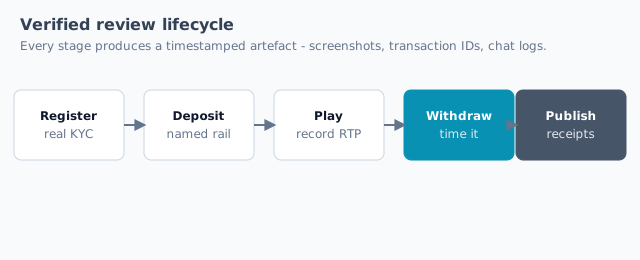
The specific point where marketing-first and evidence-first reviews diverge most is on the withdrawal completion timestamp. Marketing-first reviews typically stop at the moment the withdrawal is requested, because that is when the story is most flattering to the operator. Evidence-first reviews wait for the money to appear on the reader's own bank statement, and only then note the elapsed time. The gap between those two definitions of "withdrawal time" can be days, and it is where consumer expectations get set incorrectly by imprecise reviewing.
| Artefact | Where it lives | Difficulty to fake |
|---|---|---|
| Lobby screenshot | Public site | Trivial |
| Bonus wording screenshot | Public site | Trivial |
| Account balance page | Logged-in view | Moderate |
| Transaction ledger export | Logged-in view | High |
| Live-chat transcript with session ID | Support system | High |
| Bank/e-wallet statement line | Third-party record | Very high |
Sockpuppet detection - fake positive reviews
A sockpuppet is a fake positive review posted by the operator itself, or by a marketing contractor working for the operator. Sockpuppets are extremely common on general review aggregators and are the reason many aggregator scores hover unnaturally high on operators that produce visible complaints elsewhere.
You can identify sockpuppet patterns without any special tooling. Look for clusters of five-star reviews posted within the same 48-hour window from accounts with no history. Look for reviews that praise attributes the aggregator does not track (a payout time review for an operator whose aggregator page has no payout time field). Look for phrasing that matches, word-for-word, marketing copy on the operator's own website.
A single suspicious review is not sockpuppet evidence. A pattern of them is. When you see the pattern, discount the aggregator score by the estimated volume of sockpuppets and see whether the residual score is still worth acting on.
A related pattern worth noting is what a reviewer might call "the freshly-hatched aggregator page". You occasionally encounter an operator whose Casino Guru or AskGamblers page was created only weeks before a wave of high-rated reviews arrived. That timing pattern is not evidence of fraud on its own, but it should raise the bar of scrutiny. Long-lived aggregator entries with a steady drip of mixed reviews are, statistically, more informative than short-lived entries dominated by a single review burst.
Brigading and coordinated negative reviews
The mirror image of the sockpuppet is the coordinated negative review - "brigading" - where a competitor, disgruntled ex-employee or organised community drives one-star reviews at an operator over a short window.
Brigading is less common than sockpuppetting because the incentives are weaker (there is no direct affiliate revenue in a negative review), but it happens, especially around high-profile disputes.
The tells are similar - clusters over a short window, phrasing that repeats across accounts, focus on a single incident. Where brigading is present, the aggregator score under-reads the operator's true quality. Applying discounts in both directions gets you closer to a real signal than trusting the raw score in either.
Both sockpuppetting and brigading are, at their root, incentive-driven distortions of the review commons. The best defence a reader has is the same tool a professional reviewer uses: refuse to draw conclusions from a single source, however plausible it sounds, and instead triangulate across at least two independent aggregators plus at least one forum whose moderation you trust.
Forum verification - how communities check claims
Independent forums - the older casino-affiliate-portal forums, general gambling communities, and Reddit-adjacent spaces - have their own verification norms that are frequently stronger than aggregator sites, precisely because forum reputation compounds over years.
Common forum-verification techniques include: a moderator requesting a screenshot of the disputed transaction with a timestamp inside a fresh session, the operator's public representative being asked to respond in the thread, and long-standing forum users vouching (or refusing to vouch) for either party's version of events.
Not all forums are equal. The ones worth reading tend to have long histories, active moderation, and rules that discourage affiliate spam. A forum whose top posts are all promotional links to operator sign-up pages is not doing verification work; it is doing marketing work.
Forums do age. A community that was reliable five years ago may have degraded, or vice versa. When you settle on one or two forums as reference points for verifying claims, revisit that choice annually. Look at whether the moderation is still active, whether the top-thread reputation still tracks operator quality reasonably well, and whether the community's tolerance for affiliate-linked promotion has changed.
Aggregator verification - AskGamblers and Casino Guru
Two aggregator sites have built moderately reliable verification practices for offshore-operator complaints: AskGamblers and Casino Guru. Both mediate disputes between players and operators, both publish complaint counts and resolution ratios, and both maintain moderator involvement in individual threads.
Their reliability is not perfect. Both accept advertising from operators. Both have been criticised at various times for uneven treatment of specific operators. That said, when you compare the complaint volume and resolution ratio on both sides simultaneously, you get a fuller picture than trusting either site alone.
A useful heuristic: an operator that shows well on both aggregators is more likely to be reasonable than one that shows well on only one. An operator that shows badly on both is very likely to have real problems. Divergence between the two is worth investigating - usually it points at a specific complaint type that one aggregator handles better than the other.
The limits of verification
Verification is not a guarantee. Even a fully-verified review can be superseded by a change in operator ownership, a licence problem, or a shift in payment-processing terms. A verified review made in March 2026 is not automatically valid in November 2026.
The way to handle that is to date every claim and to prefer reviews that are refreshed regularly. A review that reads "as of April 2026, median withdrawal was 26 hours" is honest about its own temporal validity. A review that reads "fast withdrawals" without a date is doing something else.
This site refreshes its payout and support figures quarterly at minimum, and prefaces every published number with the test date so the reader can weigh the age of the evidence.
The way a fair review handles its own uncertainty is worth watching. A review that hedges every claim into meaninglessness is not useful; a review that overstates its own confidence is worse. The best pattern is to attach a specific test date to each concrete claim and to be explicit when a claim has not been re-verified since a given date. Readers can then price the age of the evidence themselves.
Uncertainty also cuts the other way. An operator's poor score today may reflect events that have since been corrected. Where a rebrand, ownership change or licence renewal has occurred, it is legitimate to re-test from scratch under the new configuration rather than carrying forward historical scores that no longer apply.
How this site verifies its own reviews
The verification approach used here is described so you can apply it (or reject it) with full information.
- Real funded account under a real name, with normal KYC.
- Deposits and withdrawals in amounts a normal player would use - typically £30-£200 at a time.
- Play sessions over at least two calendar weeks, on a mix of slots, table games and where relevant live-dealer.
- Explicit withdrawal test at the end of the review window, timed to the minute.
- Support-chat pings across UK daytime and 03:00 GMT windows to test practical 24/7 coverage.
- Public archive of the transaction ledger with personal-identifying fields redacted.
Any deviation from the method - for instance, when an operator refuses to open an account under standard KYC - is disclosed in the review. Absence of a full cycle is disclosed rather than glossed over.
Frequently Asked Questions
How do I know a review is really "verified"?
Look for artefacts that could only exist if the reviewer opened a real account: transaction ledger screenshots with dates, session IDs, chat logs. If those are absent, the "verified" label is nominal, not real.
Are all aggregator complaints trustworthy?
No. Sockpuppetting and brigading both exist. Look at the pattern of complaints, not the raw count, and cross-check between aggregators.
Why do some verified reviews still get things wrong?
Because operators change. Ownership shifts, licences renew, payment processors change. A verified review from six months ago may not reflect the current state, which is why refresh dates matter.
What redactions are acceptable in a verified review?
Personal identifiers - the reviewer's real name on account pages, bank account numbers, addresses. Operator-side identifiers - transaction IDs, session IDs, licence numbers - should stay visible so a reader can cross-check.
Do you accept operator responses to reviews?
Yes. Any operator that disputes a specific finding is invited to respond through the contact page. Substantive responses are appended to the review.
What is the single most easily faked review artefact?
Lobby screenshots. Anyone can capture them. The hardest to fake are transaction-ledger screenshots, which is why the methodology emphasises them.
Do you use anonymous accounts to review?
Accounts are real, under real KYC. The reviewer's identity is not publicly displayed for personal-safety reasons, but the operator has, at the time of review, a real customer record.
Responsible Gambling
Verified reviews are a consumer-protection tool, not an invitation. GamStop remains a legitimate self-exclusion scheme, and no amount of review verification changes the underlying purpose of that scheme. If you are self-excluded, please respect that decision.
UK problem-gambling resources include GamCare (0808 8020 133), GordonMoody, the NHS National Gambling Clinic, BeGambleAware, and GAM-Anon. These are text mentions - please look them up directly.
Background: sockpuppet accounts on Wikipedia, astroturfing on Wikipedia.