
Why the weights are published, not hidden
Publishing the criteria weights is a small act of professional courtesy to the reader. It is also the difference between a review method that can be tested and one that cannot. When a non gamstop casinos review site refuses to show the weights, it is implicitly claiming that a proprietary formula produces a truer score than a transparent one. That claim is usually wrong. Transparency is not a weakness in a rating framework; it is a prerequisite for the score to be meaningful.
The current weights, laid out in this document, apply for the whole of 2026. Any change to the weights themselves will be announced at the top of this page and archived so that previous scores can be reconstructed under the previous weights. Changes to the individual operator scores under a stable weighting happen regularly as the underlying evidence changes.
The overall structure allocates 65 per cent of the score to the three dimensions where offshore-operator failure most damages a consumer: licence quality, payout track record and terms fairness. Support and technical transparency together take 35 per cent. The balance reflects what actually goes wrong.
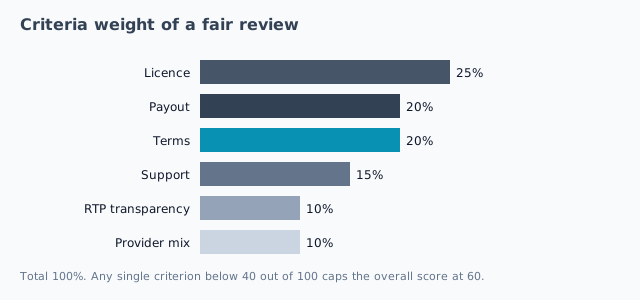
Transparency also allows disagreement to be productive. If a reader believes the licence weight should be 30 per cent rather than 25, that is a substantive editorial argument that can be debated. If the reader has no access to the weights, they cannot even frame the argument. The published rubric is, in that sense, an invitation to critique - not a defensive posture.
Licence and enforcement - 25 per cent
Licence and enforcement quality carries 25 per cent of the score - the largest single line. It is broken down as follows.
- Licence class and jurisdiction (10 points out of 25).
- Public-register verifiability (5 points).
- Entity match between operator terms and licensee (5 points).
- Enforcement history - documented actions against similar operators in the same jurisdiction (5 points).
An operator with a valid MGA licence, entity match, and a jurisdiction with visible enforcement history will score well on this line. An operator with a valid Curaçao licence, no entity match on the terms, and a jurisdiction whose enforcement register is opaque will score middling to poorly. An operator whose licence identifier is not in the public register receives zero on this line and triggers the cap rule.
Licence weight is the largest because a failure on licence is the failure with the fewest workarounds. Every other dimension has some form of remedy or discount; a broken licence has none.
Some readers will object that licence quality is being over-weighted at 25 per cent because "licences are all fake anyway". That is not accurate. Offshore licence quality varies enormously, and the differences are visible in enforcement outcomes over long periods. A weight of 25 per cent reflects that variance, not a naive assumption of universal licence quality.
Payout track record - 20 per cent
Payout track record carries 20 per cent, tested through direct withdrawal experiments plus complaint-aggregator cross-check.
- Median withdrawal time (10 out of 20).
- Withdrawal-cap fairness relative to deposit ceiling (5 points).
- Rate of "additional verification" holds on standard withdrawals (5 points).
Direct withdrawal experiments run at least four separate withdrawals across the review window at different amounts and different payment rails. Complaint-aggregator cross-check compares the direct experiment result against the resolution ratio and complaint pattern on AskGamblers and Casino Guru over the same period. Divergence between the direct experiment and the aggregator picture is investigated.
The 20 per cent weighting reflects the fact that payout is the single most concrete outcome an operator delivers. Every other dimension is upstream of payout in some sense.
An operator that pays quickly in its first six months and slowly thereafter is a specific pattern worth watching for. Some newer operators pay eagerly during their acquisition phase and slow down as marketing costs bite. That is why the payout dimension is tested repeatedly across the review window, not once at the start.
Terms fairness - 20 per cent
Terms fairness carries another 20 per cent. It is broken into five sub-items.
- Wagering multiplier reasonableness (5 out of 20).
- Withdrawal-cap generosity (4 points).
- Sole-discretion clause scope (4 points).
- Dormant-account fee reasonableness (3 points).
- Bonus-play maximum-bet cap clarity (4 points).
Terms are scored by reading them - not by summarising them. Quotations are captured for the review file. The scoring rubric on each sub-item is anchored: for example, a wagering multiplier of 25x on bonus alone scores 5/5, 35x on bonus alone scores 3/5, 40x on deposit-plus-bonus scores 1/5, and anything above scores 0/5.
Anchoring is what makes the scores replicable. Two readers applying the same anchors to the same terms should arrive at scores within one point of each other.
Terms scoring is the dimension most vulnerable to reviewer disagreement, because "fairness" is partly a normative judgment. The anchoring rubric tries to strip out the normative element by tying scores to specific numeric thresholds, but readers may reasonably disagree with individual anchors. Those disagreements are welcomed, and any well-argued case for adjusting an anchor is considered on the annual weights review.
Support quality - 15 per cent
Support quality carries 15 per cent, broken into three sub-items.
- Median chat response time under 60 seconds (6 out of 15).
- Substantive-resolution accuracy on a benchmark question (6 points).
- Escalation-path clarity (3 points).
Median chat response is measured across at least eight support-chat pings across a mix of UK-daytime and non-UK-daytime hours. The benchmark question is a specific, factual question with a right answer - typically the maximum withdrawal per month on the operator's terms - and the agent's response is graded on correctness. Escalation-path clarity looks at whether the support desk can, when asked, cleanly identify a supervisor or a written complaint route.
Support weight is 15 per cent rather than higher because friendly support does not compensate for a broken payout process. It matters, but it matters less than the outcomes support is meant to protect.
One nuance: support quality is not just about response speed. A slow but accurate response is worth more than a fast, incorrect one. The rubric captures this by scoring resolution accuracy on a benchmark question separately from median response time. An operator that answers instantly with the wrong figure does not score better than one that takes twenty minutes to give the correct figure.
RTP transparency - 10 per cent
RTP transparency carries 10 per cent, tested by sampling ten popular slots and comparing the RTP shown in the game info panel against the value on the provider's own documentation.
- Agreement between info-panel RTP and provider documentation across the ten sample titles (7 out of 10).
- Existence and visibility of the game info panel itself (3 points).
Agreement in this context means the two figures match. If eight out of ten titles agree and two are missing information, the score is 6/7 on the first sub-item. If any title shows a higher RTP in the info panel than the provider documentation supports, that is a categorical failure and the sub-item scores zero.
The weight is 10 per cent rather than higher because most operators handle RTP display reasonably well; the dimension mostly separates the very worst operators from the mainstream, without discriminating strongly among the mainstream.
Provider mix - 10 per cent
Provider mix carries the remaining 10 per cent. It is scored by inspecting the lobby, listing the providers, and applying a simple recognition test.
- Number of tier-one providers present (6 out of 10, one point each up to six).
- Absence of unattributable clone titles (2 points).
- Recent additions - evidence of active provider maintenance in the last six months (2 points).
Tier-one providers are the studios you already recognise from mainstream UKGC-licensed sites. The specific studio names are not reproduced here to avoid the impression of endorsing operators that carry them, but any reader can compile the list in five minutes by inspecting the lobbies of two or three well-established UK-facing sites.
Provider mix is genuinely a proxy signal - it correlates with, but does not cause, operator quality. Ten per cent reflects that correlational rather than causal role in the scorecard.
The 40-60 cap rule
The 40-60 cap rule is the single most important structural feature of the scoring model. It says: on the three most important dimensions (licence, payout, terms), a score below 40 out of 100 caps the operator's overall score at 60 regardless of anything else.
The rationale is that no amount of pleasant support, transparent RTP or attractive provider mix compensates for a broken licence, a poor payout record or unfair terms. If the operator fails a foundational check, the operator has failed - the score should not reward compensations elsewhere.
Concretely: an operator with 30/100 on payout, but 90/100 on everything else, will not appear as an 82-scoring operator in the table. It will appear at 60/100 with a footnote naming the failing dimension. Readers can then decide whether the compensations are worth the cap.
The 40-60 threshold is deliberately not a full disqualifier - some readers may value support or provider mix highly enough that they want to see the cap-affected score anyway. It is a signal, not a filter.
The alternative to a cap rule is a pure weighted-mean score, and pure weighted means have a well-known failure mode: they let very high scores in one dimension mathematically compensate for very low scores in another, even when that compensation makes no consumer sense. The 40-60 cap rule is the crudest way to close that gap without introducing complicated nonlinear scoring formulas that would themselves be harder to publish transparently.
A worked example - scoring a hypothetical operator
Consider a hypothetical operator "Operator X" with the following measured sub-scores. All values are illustrative.
| Criterion | Sub-score / 100 | Weight | Weighted contribution |
|---|---|---|---|
| Licence & enforcement | 72 | 25% | 18.0 |
| Payout track record | 58 | 20% | 11.6 |
| Terms fairness | 44 | 20% | 8.8 |
| Support quality | 78 | 15% | 11.7 |
| RTP transparency | 90 | 10% | 9.0 |
| Provider mix | 66 | 10% | 6.6 |
| Total (uncapped) | - | - | 65.7 |
Because all three of licence, payout and terms scored 40 or higher, the cap rule does not activate, and the published score is 65.7 / 100. Had terms fairness scored 38 instead of 44, the same operator would have been capped at 60.0 with a footnote naming terms fairness as the capped dimension.
This is the entire calculation. It fits on a page, it is checkable by any reader, and it does not require trusting the reviewer to have "the right feel" for offshore operators.
Any reader who wants to work through their own worked example can do so with the published anchors on each dimension. Start with the sub-scores for the operator you care about, multiply each by its weight, add them up, and then apply the cap rule. Nothing about the calculation should be hidden.
A worked example is easier to audit than a formula. Any reader can plug their own numbers into the same grid, verify each contribution, and independently reach the same total. That auditability is the whole point of publishing a rubric of this shape - readers do not have to trust the scorer, they can check the scorer, which is a materially different and stronger position for a consumer resource to sit in. Auditable scoring is also, quietly, a discipline on the reviewer, since every number has to be defensible in isolation.
Frequently Asked Questions
Are the weights the same for every operator?
Yes. Every non gamstop casinos operator in the review pool is scored under the same weighting. Comparative fairness requires it.
How often are the weights themselves updated?
At most once per year. Any change is announced at the top of this page and archived. Between updates, only individual operator sub-scores can move.
Why is licence weighted higher than payout?
Because a broken licence has no downstream remedy. A slow payout has some remedies through complaint aggregators; a licence that does not exist does not.
Can an operator score 100 out of 100?
Structurally yes, but in practice no offshore operator has done so. The scoring anchors are set strictly enough that above 90 is unusual.
What happens if an operator disputes a sub-score?
Operators can respond through the contact page. Substantive corrections are applied and the change is noted with the reason.
Does the scoring reward newer operators or established ones?
Neither, structurally. But newer operators tend to score lower on payout track record simply because there is less evidence to draw on. That is a limitation of the evidence, not a bias in the weighting.
Is there a walk-away score below which no operator should be used?
The framework does not name a hard threshold. In practice, an operator below 55 has multiple problems and a reader would want a very specific reason to prefer it.
Responsible Gambling
Rating criteria are a consumer-information tool. They do not change the underlying reality that offshore operators fall outside the UK statutory framework. If you are registered with GamStop, please respect that self-exclusion regardless of what any rating shows.
UK problem-gambling support is available through GamCare (0808 8020 133), GordonMoody, the NHS National Gambling Clinic, BeGambleAware, and GAM-Anon (for family members).
Background reading: rating scales on Wikipedia, weighted mean on Wikipedia.