
What a decision framework actually is
A decision framework is a repeatable set of checks you can apply before you deposit at a non gamstop casinos operator. It is not a promise that everything will go well - offshore operators are, by design, outside the UK statutory safety net - it is a way of forcing yourself to look at the same information every time, in the same order, so that emotion does not push you into a hasty account opening.
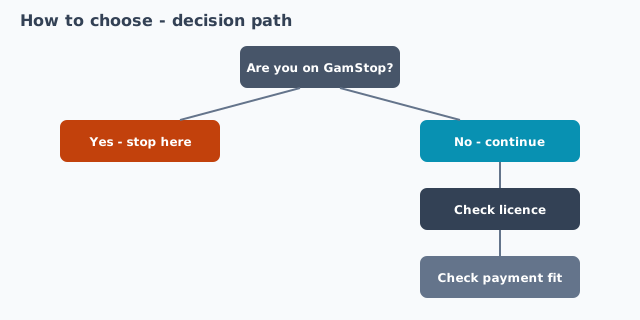
The framework this page describes runs through eight checks. Each one is quick on its own; the point is doing them all, and doing them in order. The order matters because some checks are dealbreakers. If a dealbreaker fails, you stop and do not proceed to the later checks.
The most common reason people end up at an operator they regret is a rushed decision. A framework is not a bureaucratic delay - it is a way of slowing the decision down enough to notice the details that would otherwise be missed.
The self-exclusion check comes first, always
Before any operator-specific check, the framework asks one question. Are you registered with GamStop? If the answer is yes, the correct action is to stop. GamStop is not a technical obstacle to overcome - it is a decision you made about your own gambling, and the point of self-exclusion is that it applies to you, not just to sites that happen to be UKGC-licensed.
Offshore operators are not required to check GamStop and cannot enforce it on your behalf. That does not change the underlying reason you registered. If you registered because your gambling was becoming difficult to control, an offshore operator is precisely the environment in which that difficulty is amplified - higher deposit ceilings, faster deposits, weaker affordability signals.
If you are self-excluded, the healthiest next step is to talk to someone. GamCare operates a helpline on 0808 8020 133. GordonMoody offers residential treatment. The NHS National Gambling Clinic offers specialist NHS support. BeGambleAware provides self-assessment tools. GAM-Anon supports affected family members. None of these need to be called by name in the browser bar - a text mention here is deliberate, and each can be looked up directly.
How to run a licence check that means something
Assuming the self-exclusion check passes, the next step is to look at the operator's licence. Every legitimate offshore operator publishes a licence identifier in the footer of its website. That identifier should link through to a public register.
The three licensing frameworks you will encounter most often are Curaçao GCB, Anjouan Offshore Gaming, and MGA (Malta Gaming Authority). A licence-check that means something involves four steps.
- Locate the licence identifier at the footer of the operator homepage.
- Click through and confirm the link resolves to the public register of the named regulator.
- Confirm the entity name on the register matches the entity name on the operator's terms and conditions.
- Note the licence class and expiry date. A licence that has renewed recently is worth more than one three months from expiry.
What you are checking against is the common failure pattern: an operator that displays a licence logo but does not link to the register, or links to a register that does not list the entity. Both are red flags. A well-run offshore operator makes the licence verifiable in under a minute.
A subtle detail that is worth learning: some operators run several brand skins on a single underlying licence. If you notice that the entity name on the terms matches an entity that also operates six or seven other brands, that is not automatically a problem, but it does mean any dispute you have with one brand is effectively a dispute with a larger organisation. Understanding the corporate footprint changes the character of your recourse. The same corporate group may make different commitments to different brand identities, and the licence itself only regulates the entity, not the brand.
Payment fit - can you actually deposit and withdraw?
Payment fit is the third check because it is the most likely reason a technically fine operator will not work for you in practice. UK card issuers can decline transactions to offshore gambling merchant category codes. Some banks block them entirely; some allow them intermittently; some route them successfully but restrict withdrawals.
Before you deposit meaningful amounts, do a small test. Deposit a token amount using the payment method you plan to use. Wait ten minutes. Withdraw the same amount. Time the round trip. If either leg fails, or if the withdrawal requires additional verification you did not expect, you have learned something before it mattered.
Payment fit also covers the mundane question of what methods the operator actually supports. Debit cards, e-wallets, bank transfer, and cryptocurrency rails are the four common categories. Each carries different processing times, different fee structures, and different reversal characteristics. Choose the method whose profile you understand and whose withdrawal channel you have tested.
KYC realism - what verification will look like
KYC - Know Your Customer verification - is the source of a large fraction of the complaints you will find on any offshore-operator aggregator. The reason is not usually that KYC exists, but that it is applied late.
Reputable offshore operators require identity documents, proof of address and proof of payment method - the same set a UKGC-licensed operator requires. The difference is timing. UKGC operators typically verify at, or shortly after, account opening. Many non-UKGC operators verify only when you attempt a withdrawal, particularly a larger one. That is called delayed KYC, and it is the most common reason people report being surprised by a document request.
The way to be prepared is to assume delayed KYC is the default. Have your ID, a recent utility bill (within three months), and a bank statement covering the deposit ready before you deposit. If the operator supports document upload before your first withdrawal request, use it. Any delay caused by KYC starts the clock on any promised payout time.
Dispute expectations at an offshore operator
At a UKGC-licensed operator, if the operator refuses to pay a valid withdrawal, you have a statutory dispute route through the UK Gambling Commission and through IBAS (the Independent Betting Adjudication Service). At an offshore operator, neither of those routes exists.
What does exist is the offshore regulator's own complaint framework. Curaçao has published complaint procedures. Anjouan has a similar arrangement. MGA operates a documented complaint-handling process that many players find responsive. In practice, dispute outcomes at offshore regulators are more variable than at the UKGC, and timelines are generally longer.
The realistic expectation is this. If you play at a well-licensed offshore operator, and you present a documented complaint through the regulator's channel, the odds of a resolution in your favour are non-zero but not high compared to the UKGC route. If the operator's terms include a mandatory arbitration clause, that route replaces the regulator route.
Public complaint aggregators - AskGamblers and Casino Guru are the two most-cited - also mediate informally with operators. They are not a legal remedy, but they are frequently effective for smaller disputes.
You should also form a realistic view of enforceable-value ceilings. In practice, the amount of money at stake in a dispute strongly affects what remedies are worth pursuing. For a £30 dispute, the sensible response is often to write off the loss and move on. For a £3,000 dispute, it is worth going through the operator's internal complaints escalation, then the offshore regulator, then a complaint aggregator, in that order. For a £30,000 dispute, it is worth involving a solicitor who understands cross-border e-money and consumer disputes - though the fees involved can quickly outweigh the sum in dispute.
Terms and conditions - the red flags to spot
The terms document is where operator behaviour is licensed to itself. Skimming it before deposit is the last cheap check you can do. The five clauses to search for by keyword are listed below.
- Maximum withdrawal. Look for a weekly or monthly figure. Compare it to the maximum you plan to deposit in a single evening. If the withdrawal cap is smaller, note that.
- Wagering multiplier. Look for the multiplier and, critically, what it is applied to (bonus alone, or deposit-plus-bonus). The latter is materially more onerous.
- Maximum bet with bonus funds. A common trap: winning above this cap is voided even if you stayed within the multiplier.
- Irregular play / advantage play. An open-ended clause that allows the operator to void winnings for undefined behaviour. Read it. Note it.
- Dormant account fees. Look for the fee, the timeline (typically 3, 6 or 12 months of inactivity), and whether the fee applies to your balance or the credit balance only.
You are not looking for terms that are entirely absent - all offshore operators have terms of this shape. You are looking for the specific numbers, and for any clause phrased so broadly it could be applied arbitrarily.
A useful technique is to save the terms as a PDF the moment you finish reading them, so that the exact version of the document you agreed to is preserved. Offshore operators do update their terms - occasionally without headline notice - and having a dated copy of the version you accepted at account opening is an evidential asset in any dispute that follows. Reputable operators publish a change log; less-reputable ones do not, which is exactly when a personal archive matters most.
| Clause | Typical wording | Red-flag threshold |
|---|---|---|
| Weekly withdrawal cap | "Maximum X per calendar week" | Cap below single-evening deposit ceiling |
| Wagering multiplier | "40x wagering applies" | Above 45x, or applied to deposit + bonus |
| Max bet with bonus | "Max stake £5 during bonus" | Cap not stated at all |
| Irregular play | "Sole discretion to void winnings" | No defined criteria at all |
| Dormant fees | "3-month dormant fee applies" | Applied to full balance, not credit balance |
Cross-checks before you deposit
Before depositing meaningful funds, apply three cross-checks against independent sources. These take another five minutes.
- Search the operator name plus "complaints" on a general search engine. Read the top three results.
- Search the operator name on at least one complaint aggregator (AskGamblers, Casino Guru). Note the resolution ratio and complaint pattern.
- Search the operator's parent-company name (from the terms). Sometimes the reputation attached to the parent is more informative than the operator brand.
None of these cross-checks are conclusive on their own. The pattern is what matters. An operator with no complaints, no reviews, and no historic record is not necessarily good - it may simply be new. A brand-new operator carries different risks from an established one, and there is no substitute for waiting six months and letting other people find the problems first.
Working through these three cross-checks in sequence takes about eight minutes if you already have the operator name in front of you, and about fifteen if you are starting from scratch and need to find the parent-company name in the terms document. Neither is a large investment relative to the sums you might otherwise deposit. The friction here is not the researcher's; it is the shape of the offshore market itself, which does not standardise the disclosure of parent-company relationships in the way a UKGC-licensed operator is required to. Building a small habit around these cross-checks converts an ad-hoc, emotion-loaded decision into a set of small, checkable steps.
Also worth doing at this stage: search the operator's own domain on the Wayback Machine and see whether the terms of service have changed materially in the last twelve months. Silent, unannounced changes to withdrawal caps or wagering multipliers are worth spotting, and the archived version of the terms is one of the few places that record survives.
When to walk away entirely
There is a short list of hard walk-away signals. If any of these appears, the framework says stop, regardless of how attractive the bonus looks.
- The licence identifier is not verifiable in the regulator's public register.
- The entity name on the terms does not match the entity name on the licence.
- The support desk cannot answer, in writing, what the maximum weekly withdrawal is.
- A recent complaint aggregator shows more than three unresolved payment complaints from within the last 60 days.
- Your payment method does not process a token round-trip deposit and withdrawal without additional friction.
- The site displays testing-lab seals that do not link to a current certificate.
Walking away is the easiest and cheapest risk-management decision available. The offshore market is large enough that one operator saying no does not shut you out - it simply means the next check in the framework takes over.
Frequently Asked Questions
Do I need to be a UK resident to use the framework?
The framework applies to any UK-resident reader considering offshore-licensed operators. The self-exclusion check specifically references GamStop, which is a UK register; if you are outside the UK, replace that with your local self-exclusion scheme.
Which licence should I prefer - Curaçao, Anjouan or MGA?
MGA is generally the strongest of the three from a consumer-recourse perspective. Curaçao is the most common. Anjouan is newer. Preference alone is not decisive - the operator's own record within the licensing framework matters more than the framework's average.
How small is a "small test" deposit?
Small enough that losing it entirely would not affect you. Most people use an amount equivalent to a single meal out. The purpose is not to win - it is to test the deposit-and-withdrawal round trip.
How long does a typical delayed-KYC verification take?
At well-run offshore operators, one to three business days from complete document submission. At poorly-run ones, or where documents are challenged, one to three weeks. Have your documents ready before you deposit.
What if I cannot find the licence identifier in the footer?
That is itself a signal. A legitimate operator publishes the identifier prominently. If you cannot find it in under a minute, the framework treats that as a walk-away signal.
Should I trust an operator that markets itself as skipping identity checks entirely?
No. Any operator that advertises the absence of verification is either misrepresenting its own policy - most jurisdictions require some form of KYC at withdrawal thresholds - or operating outside its own licence framework. Either way, treat it as a walk-away signal.
Where does the framework live in future?
On this page. The framework is versioned - any change to the sequence or the walk-away criteria is announced at the top of this page and archived on the rating criteria page.
Responsible Gambling
Framework use does not replace responsible-gambling practice. GamStop is a legitimate national self-exclusion scheme, and if you are on it, the framework's first check is designed to stop you. If you have found yourself here despite being self-excluded, that is a signal worth taking seriously.
UK problem-gambling support is available through GamCare (0808 8020 133), GordonMoody, the NHS National Gambling Clinic, BeGambleAware, and GAM-Anon (for affected family). Please look these up directly; on this page they are text mentions by design.
Consumer background reading: self-exclusion on Wikipedia, KYC on Wikipedia.